Monday, June 22, 2015
Ghost Story - The Image and the Reality (Demo) [1990]
The truth hurts. While so many undeserving acts receive recognition and pundits beyond belief, those whose fates are as tragic and fragmentary as Ghost Story becomes lost in the billowing wind. Fortunately, with the technological benefits ushered in by the 21st century, hunting down an obscure demo such as the Atlanta quartet's ''The Image and the Reality'' becomes a much easier task than to have acquired the demo by tape trading in the early 90's. Ghost Story and their second demo are significant for two reasons: not only does the sound existing within these five tracks possess the potential to champion most thrash or speed metal outings that were being put out by 1990, but the sound itself is quite unique, a stunning tribute to the power/speed/thrash traditions of the 80's that, without conspiring to move the genre's foundations in any manner, manages to become one of the most potent and memorable heavy metal demos of all time.
Yes, you heard it right, and the joke is on you if you're smirking behind your PC reading this, smiling at the laughable crudity of the cover art, because ''The Image and the Reality'' is fantastic. There is no tandem to quality here, since each track serves equal portions of ass-kickery, but I love that the band diverges from the linear thrashing simplicity or speed/thrash filth offered by so many of its peers, and a general feel of power metal here runs parallel to the well-forged arsenal of riffs, which are entirely memorable excursions into the wide fulfillment of the genre at large, and you're bound to hear anything from ''Rust In Peace'' era Megadeth to more progressively oriented speed/thrash a la Angent Steel, Toxik, Coroner and Watchtower to more obscure power/thrash acts from the early 90's like Mystik or Stygian. There is a certain hooking quality to the riffs that makes them both immensely entertaining and also slightly moving. ''I Won't Change'' is a good example, with a broad thrashing rhythm accentuating the verses and moodier breaks into ballad-esque arpeggios and melodic guitar solos. But the group also harnesses these chugging, looming that feels completely satisfying in terms of mood and sway, with pure wisps of clear power metal melody reminiscent of early Fates Warning crowning the remaining bits and pieces. Of course despite the marginal variants, Ghost Story's focus remains a furious dialect of speed and thrash metal, like the excellent verse of ''Repent'', full of twisting but uncomplicated riffs which sound like an awesome addendum that Dave Mustaine forgot to add to his first two Megadeth discs. At any rate, the rhythm section remains extremely tight and killer, with no frugality of headbanging material.
Rob Thompson's vocals here are part of what makes the demo so damn unique. A versatile detachment from the classic harsh Teutonic rasp, but retaining enough audibility, poignancy and an arousing timber to sound fresh, I'd say he sounds like a more controlled, gruffer Sean Killan, but all the same he can seamlessly weave into a different tone according to the undercurrent of guitars: granted, he doesn't feel like a majestic soaring banshee destined to bewilder a listener as on a classic like ''Think This'' or ''Control and Resistance'', but he still sounds almost immediately distinguishable than the umpteenth 80's thrash rehash I'd hear. For a demo, the production here, just like everything else, reigns supreme. Sure, you might need to raise the volume a tad before you can really hear the music, but the drums have a crisp tone to them and never perambulate in terms of volume as on an occasional demo recording; the guitars are copious but they never overfeed the mix; and the bass is surprisingly audible in a Steve Harrison kind of way, ballasting the metallic crevices of the guitars with some sweet, raw lines. In terms of instrumentation, Ghost Story sure dwell into a lot of 'contemplative' discourse riffing, more often than a regular thrash act, but the long moments are never dull as to cull boredom from the listener and they're smart enough to break off from the more melodic, moody instruments-only plateau just in time to cut into a fierce chorus or bridge. Every song is truly legendary here, within its minimal cult status: from the introductory arpeggios of ''I Won't Change'' to the irresistible chorus on ''Silent Masses'' to the unforgettable gap riff midway ''What Few Even Dare'' which has stayed with me ever since my first spin, ''The Image of the Reality'' is one of those rare recordings, which, assuming the shape of another abstruse obscurity, heightens to the level of a full-length, beating so many at their own game that it makes my flesh prickly just thinking about it. Truly, its only fault is its brevity and slightly cramped production that feels only natural. Otherwise, find this at all costs, and if you're a collector of heavy metal demos, you've already wasted your time reading this reviewer's fanboyish rant about it.
Highlights
''Sanity Web''
''What Few Even Dare''
''Silent Masses''
Final Rating
Masterpiece [9/10]
Sunday, June 14, 2015
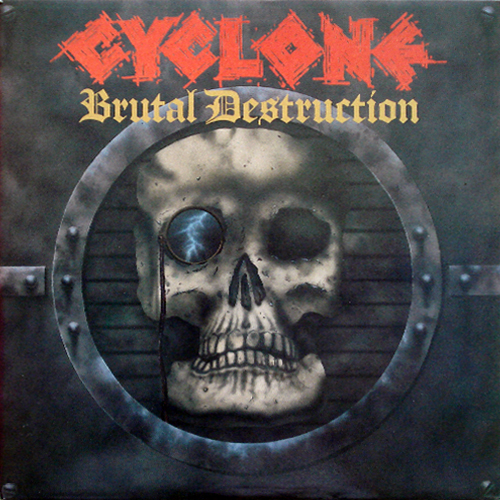
Cyclone - Brutal Destruction [1986]
It might be a sad fact that Cyclone suffered from anachronisms throughout their brief career, but they nevertheless managed to emerge as one of the best Belgian thrash outfits with only two full-lengths at their belt. While their sophomore was a tour de force in the realms of classic, albeit chunkier Bay Area thrash, complete with a characteristically dark and alluring atmosphere, back in 1986, when Bay Area thrash was just finding its way around the woodwork with cornerstones like ''Master of Puppets'', ''Reign in Blood'', ''Darkness Descends'' and ''Bonded By Blood'', the Belgians were keeping more to the German rule book, boasting a vicious, uncompromising Teutonic aesthetic which Kreator, Destruction, Sodom and Tankard were promulgating at the time, doused in speed metal. As crazed and energetic it may seem to purists, ''Brutal Destruction'' is not the most memorable piece to be excavated from its time, even though the Belgians obviously had a good head start.
Cyclone always seemed one step behind the world, which is probably why they were lost in the throngs. Had this record come out 2-3 years before its release, it would easily had been hailed as one of those cult pre-'85 recordings, with ragged production values and undiluted, sporadic speed/thrash riff ballasts supporting its cult status. But that's not the case here, since ''Brutal Destruction'' feels like an average ringlet in the whole circular universe of thrash recordings, even at a time when the genre was still fresh and malleable. Still, that's not to say ''Brutal Destruction'' is bad; while I'd still say this isn't as impressive or technical as something Dave Mustane would have crafted at the time, speedy guitar licks and delicious lead snippets inserted into a broader, savage thrashing undercurrent, Cyclone is notably 'German' here, with a sound that reminds one of the earliest Destruction and Kreator records peized randomly and stuffed into a nice speed metal cauldron, yet not as evil as some of Sodom's early recordings, stripped almost entirely from all sense of melody. Ripping, ribald muted tremolos and occasional heavier moments that borrowed a riff or two from ''Pleasure to Kill'' give the impression that the band members where still uncertain whether they should go by a more straightforward speed/thrash aesthetic or a slightly more complex hefty thrash barge (it turns out they picked the latter in the end, although not on this record) with reasonably outrageous and corny song titles (''Take Thy Breath'', ''Incest Love'', ''In the Grip of Evil''). Unmuzzled and road-driven as these riffs are, it's hard to take Cyclone too seriously, even with the evident energy bestowed upon their performance: this is 'real' 80's metal for sure, but it also feels more moderate than the higher octane body of works that was being put out at that time.
The vocals give that frenetic Paul Bailoff effect; they're amateurish (not unlike the sophomore) but there's enough shrieking and shouting to be heard to make them enjoyable. I'm not going to lie that the guitar tone and the production levels are surprisingly impressive for a record out of 1986. The chords, the drums and even the plodding, one-dimensional base lines are all suitably integrated into the mix, and if anything, the leads, in all their frivolity, are still fairly entertaining with a sporadic blues attitude, reminiscent more of a ''Kill 'em All'' than ''Infernal Overkill''. To be honest, there are good tracks here: ''Long to Hell'' and ''Incest Love'' are both quite compilation-worthy, fiendish shouting and successively rabid riffs galore. ''Fall Under His Command'' is probably my favorite tune here, possibly because of its swirling panorama of guitar solos and a bulky, percussive main riff coupled with some more fanciful, tremolo picking episodes, but in the end, none of these tracks are really on a par with the premium material that was being released in '86-'87, nor do they cast a wide net of creative reinforcement upon the genre. Needless to say, I'd vie for the Belgians' sophomore over this any day for its sheer crushing majesty, but ''Brutal Destruction'' yet remains as one of those half-unearthed mid-80's speed/thrash gems that deserves a discovery (or rediscovery) at the hands of collectors or purists, and even beyond that it remains a spry and rampant declaration of the genre's hostility against those who supposedly flattened out its tires with tongue-in-cheek during the early 90's. Poseur-free as always.
Highlights
''Incest Love''
''Fall Under His Command''
''Long To Hell''
Final Rating
Mediocre [6.8/10]
Wednesday, June 10, 2015
Cyclone - Inferior To None [1990]
Unable to come into commercial fruition due to the financial constraints of Justice Records, Cyclone ''Inferior To None'' is perhaps one of Belgium's best-kept secrets of the 80's and early 90's, not solely for the fact that I've almost never seen a genuine metalhead give a nod towards its direction, but because it retain some of the 'classical' approach of thrash that largely dissolved by 1990. In fact, so much of this album's musical constituents are built on the foundation of ''Master of Puppets'' and a handful of other pivotal Bay Area thrash records that it's hard not to admire the Belgians' commitment to the transition from the rougher, frolicking Germanic aggression of their debut ''Brutal Destruction'' to the grandiose scale of this record, even if took them 4 years. I imagine ''Inferior To None'' was still sucked in by the painstakingly devoted heavy metal subculture existing in and around Belgium in the 90's, but even today you could count yourselves lucky if you caught a glimpse of it scanning lists or obscure forums, which is shame because this is easily one of the best Belgian thrash outings, ever: I'm not going to shake my head and moan in despair for the sheer underestimation that has entailed this record for over 25 years, but this would be a good place to start on telling you why you should start adding it to your collection.
Surprisingly, ''Inferior To None'' is less glazed and technical than, say, a band like Forbidden or Atrophy, sporting a dense, dark production quality that I can't exactly equate with any other thrash recording of the 80's or 90's. You have to give the Belgians some props because despite emerging on the dawn of groove and grunge the songs here are don't sound anything like Pantera of mid 90's Sepultura, with the groove and swagger of the rhythm is not unlike the transformation of Chastain on their 1990 ''For Those Who Dare'' which also bolstered 'groovy', even modern-ish production levels in contrast to the grainier texture of their USPM/heavy metal output in the 80's. But that aside, ''Inferior To None'' is such a dark and classy adventure full of riffs and fantastic, bulky drumming that it easily overrides the primal aesthetics of the debut, with pummeling verse riffs and lengthy songs not unlike the ones on ''Master of Puppets''. Of course the album doesn't contain one 'Leper Messiah' or 'Damage Inc.', but you can bet that the approach is similar, coated denser guitar tones and a far more ominous atmosphere than bands which were performing thrash in the early 90's; I also wouldn't say any of the songs are infectiously catchy, but honed with care and precision enough to make this one tantalizing bulk of a riff-fest.
Guido Gevels's vocals, admittedly, don't quite hit the sweet spot when it comes to operatic skill. I would compare the man to Sean Killan, but more controlled, yet despite this his fanciful singing falls perpendicular to the crushing parade of riffs and proves to transcend what might have been a painful attendance to thrash vocals 101, and instead we get a surprisingly effective performance. He'll occasionally go for a resonating shriek or bark, not unlike those of the legendary engineers of the Teutonic howl, like Millie, Tom Angelripper, or even Ron Royce of Coroner, as on ''So Be It'', and indeed even though I've dubbed ''Inferior To None'' a 'controlled' album, it only acquires that tag as an improvement over its predecessor, because there's such a wall of well balanced flesh and chaos to be enjoyed here that Gevels's raspier moments still hold credibility. To be sure, the leads here are spurious but not to the point that they're on par with the gigantic rhythm department which looms over the record like the daunting, titular door on the cover. The chugs and palm mutes are so scabrous and majestically heavy that ''Inferior To None'' doesn't always feel a far cry from a doom record, with something like ''The Other Side'' serving as a middle-paced crusher, delivering thrash justice. ''I Am The Plague'' is one the shortest pieces on the record and in my opinion, rushing and vivacious while still retaining the album's signature heft and eeriness. The band also manages to elude typical thrash/heavy/power pitfalls by supplanting a generic ballad for the beautiful instrumental ''Crown Of Thorns'', a sweeping humdinger with percussive, even anthemic drums and moody transitions.
All told, I wouldn't be able to cite so many 'golden' moments on this record since everything isn't exactly so different from one another (a few moments truly stand out) and I wouldn't have minded a greater sense of melody for a record of such depth; but in the end it all comes down to the sheer effort put into this powerhouse, which leaves me wanting for more. How many bands were performing thrash like this in '90? Devastation and Demolition Hammer would put out their respective anvils in the following few years, but those would be roving far too flirtatiously with death metal to be called 'pure' thrash. Even Sepultura would abandon the uncircumcised brutality of ''Beneath The Remains'' for something slightly more technical with ''Arise''. All the tech-thrash bands - Coroner, Toxik, Watchtower, Mekong Delta, you name it - were configuring intricate guitar palettes with machine-like precision (I actually do love their releases at that time, but that's another story) and there was little room for what Cyclone were harboring. It's far from perfect, but just settle on the ''Crown Of Thorns'' and give this disc a chance - you owe it yourself, thrasher.
Highlights:
Crown of Thorns
Slavery
Paralysed
I Am The Plague
Final Rating
Awesome [8.5/10]
Sunday, July 14, 2013
Zyklon-B - Blood Must Be Shed [1995] (EP)
It's always fun to make arbitrary guesses on what a collaboration between numerous giants would sound like if they'd ever put out a disc, though the rarity of such collaborations usually kills the inspiration to come with different combinations. What would, for instance, a concoction of Van Drunnen, Chris Reifert, Steve DiGorgio and Bob Rusay of Cannibal Corpse sound like if they ever jammed in a garage? Well, I'd kill to hear a few pieces from that combo, but what we have here is unfortunately (and fortunately) not a collaboration between these four but another quartet coming from the deep, somber woods of Norwegian black metal. Zyklon-B is probably one of the heavy metal projects with the shortest lifespan to date, with their main material centered around this 10 minute mini-disc that reeks of nothing but delirious, haunting and spectral black metal of the rawest sort, straight out of Norway when the genre was at its pinnacle, and what's more is that this isn't merely a handful of songs recorded by a group of angry teens that decided to pay a homage to their co-existing countrymen by putting on a load of corpse paint and by picking up a few battered guitars; what's utterly stimulating about the brief ''Blood Must be Shed'' EP is that it was written, and performed by some of Norway's leading tyrants of profanity: Ihsahn, Samoth, Frost, Draug Aldrahn.
The quartet, or better known collectively as Zyklon-B, are nothing short of frenetic here, with their musical profundity for pure, Scandinavian black metal displayed with stark vigor and fervor, and the sheer straightforwardness of this EP makes it not only one of the most dissolute, uncontaminated specimens the genre has in store for us, to this day. Don't get me wrong, this was actually nothing too special, even for 1995 standards, when all the giants of the scene were releasing their magnum opuses and newer, more emergent acts were just throwing in new sounds and perspectives to the genre's freshly carved out trajectory, and the four titans of this EP were nothing if not opposed to being eccentric, but ''Blood Must Be Shed'' is simply caustic, nullifying fun. There actually few black metal bands at the time that were this to-the-point with their riffing patterns and progressions, because even the bluntest of bands had something fairly different buried withing their music, so this may be one of the few releases that had a major impact of the late coming Canadian extremists Revenge and Conqueror. So bloodied are the guitars are production qualities that Zyklon-B would probably sound like your run-off-the-mill Revenge duplicate if it wasn't for the atmospheric qualities of traditional Norwegian black metal.
That's right, even though ''Blood Must Be Shed'' sounds like a cheap interpretation of war metal, it is in fact not. There's plenty of atmosphere and aura that adheres throughout the barely sufficient 10 minutes that we are presented with, and what I love about this is that most of the atmospheric tenets are enlivened by Ihsahn's unsurpassed dominion of synthesizes. He sounds just as prominent as in Emperor's flawless debut offering, though perhaps with less frequent implementation. Samoth, who roams the guitar riffs, is masterful in conveying the Norwegian sounds, having played in Gorgoroth, Emperor and Satyricon among others, Frost's drumming is also tasty; perhaps nothing out of the ordinary but will vicious, fast, and convincingly sharp, and Aldrahn of Dodheimsgard has a the inflection of a punk-induced madman screaming his lungs out as if he were upfront of Mayhem's ''Deathcrush''. The riffs are, as told, intense, like a virile bombard of razors just as deadly as the rest of the music; which is utterly relentless, unbridled. The depictions of warfare and atomic annihilation are a somewhat novel theme in black metal (at least in 1995), and I did enjoy the small helping of sound tracks, like in ''Mental Orgasm''; a brief nuclear explosion concluding the track and then rushing onto the next, and then to the rampart finale, ''Warfare'', which ends likewise as ''Mental Orgasm''.
The crappy addendum of ''Blood Must Be Shed'', ''Total Warfare'', which stretches the original length of the recording by nearly 6 minutes is utterly repelling, a completely useless remix of ''Warfare'' with additional sound effects and samples that I still find irrelevant. Nevertheless, if you get the original copy and not the 2004 reissue, the you'll succeed in refraining from it. Thanks to this rather random collaboration, we get a taste of what some sparsely scattered Norwegian black metal musicians can conjure if they ever left their bedpost. ''Blood Must Be Shed'' explores nothing, except perhaps the most destructive, ravenous facets of black metal, imbued with the raggedly interesting theme of nuclear warfare, and in its carnivorous fit of rage, listeners are likely to feel just as enraged as the band members while they were recording. In all, even when the entirety of its components are taken into consideration, ''Blood Must Be Shed'' is not willing to be more than an acidic mini black metal album, hardly deviating from the norm, but, if truth be told, I don't think any of the band members were aiming for something with spectacular grandeur. It's absolute belligerent fun that doesn't hide its true colors.
Highlights
''Warfare''
''Bloodsoil''
Final Rating
Awesome [7.8/10]
Saturday, June 29, 2013
Holy Terror - Terror and Submission [1987]
Perhaps the reason both of Holy Terror's albums are considered cult classics today is that their sound deviated greatly from their surrounding peers, and it still feels fresh today. The Californians never once shied from exhibiting their own, versatile influences, and, having an odder spectrum of influences from their counterparts who shamelessly aped Slayer, Exodus, Possessed and Metallica, I imagine they had a hard time coping with their difficulties that arose over the fact their sound was peculiar and the quite thrash machine-gun, especially considering many bands were still at their crude beginnings in 1987. Holy Terror formed in 1986, just one year prior to the release of their megalithic thrash classic, and afterwards, in 1988, they would release a sequel, ''Mind Wars'', also a tempered current of atmospheric thrash, right before disbanding in 1989. Holy Terror is now nothing but an addendum in history books, much like many of the emergent thrash acts that popped up in that period, but they've given us two wondrous classics for a multitude of glorious neck-snapping sessions, the former one being the better.
The Californians had a tight, punchy formula arranged from the start, guaranteeing triumph from the very start. Unlike so many other vile speed/thrash attractions of the time, who filtered the nasty, gritty violence of their chords with insatiable stupor, Holy Terror maintained their control with articulate diligence, and kicked asses just as intensively as, say, Toxik (''World Circus'' era), Necropolis, Blessed Death and other East Coast cults that literally sprinted with their guitar work. Of course, that's not just it. There is a delicious sense of professionalism sandwiched amid a passionate cry towards the glories of the mosh pit, and the five-piece merely play a simple helping of filthy speed/thrash here; the guitars are loaded with atmospheric considerations and can often burst into more epic proportions of thrash metal, somehow similar to the US power metal acts of the time. There is a subtle sense of western ambiance as well, certainly something you don't come across frequently, even in today's standards; a fluid, tempered set of gears motioning in a way as to allure a huge range of thrash aficionados, all rupturing through the static rawness of the core parameters of the recording.
Yes, ''Terror and Submission'' is that good. The rumbling tenacity of the rapid riff progressions are only matched by the accuracy of more complex patterns that are stitched to the broader forms of riffing to render them further interesting. I'm sure that listeners who were only mildly taken by the bulldozing plethora of riffs found themselves deeply immersed in a sea of Keith Deen's spectacular vocal performance. I'm totally going to sound like I'm kissing his ass here, but fuck, his timbre is one of the most original in the field of thrash; a hoovering range of blessed high-pitched screams that I find to be the principle ingredient to Holy Terror's cult status and atmospheric, almost ''apocalyptic'' touch. Just take ''Tomorrow's End'' as an example; the dual guitars grind their way to the atmospheric pinnacle of the album, showering the listener with a blistering rain of tremolos, all while Deen is vibrating sonorously above them, a completion of the near-flawless tune for the apocalypse. Of course, ''Tomorrow's End'' is hardly my favorite piece here. The title tracks progresses with immaculate speed and efficiency, a viscous ray of melodies constantly protruding from the stomping barrages of base rhythm, an exercise of the traditional power metal formula, practiced upon a speed/thrash basis. ''Alpha Omega - The The Bringer of Balance'' is my favorite tune out the entire 42 minute thing, and having raped the replay button with that one, I can safely say that it's one of the foremost individual speed/thrash pieces out there.
The many evocative aspects of ''Terror and Submission'' transfer a plenitude of moods and imagery into the listener's mind. Yes, it's not so emotionally resonating as an atmospheric black metal masterwork, but it will still conjure portrayals of religious war, the apocalypse and desolation, something that, much like the band's other tenets, is seldom found on other bands. The leads are spurious and unforgiving. They start spurting their content out of nowhere, a delighting discourse through the entirety of the fret board, all of which are courtesies of the two masterful guitarists. I don't see how, after such copious and extensive right hand guitar work, the guitarists still get to keep their fingers, because this is one fucking blistering ride of nostalgia that nobody's bound forget so easily. So angry and forceful and dangerous that blasting this through your stereos on a vigorous car trip with your college buddies would undeniably make someone jump right out of the car, towards escapism and beyond. Yet ''Terror and Submission'' covers a wide enough territory to both decapitate necks and swirl like a controlled, seasoned tempest. It's carefully crafted, the intricacies well applied to the music, and it stands as an enduring thrash classic. Its sequel is also a great record, but the Californians would reach their climax in 1987. Speed and blisters forever.
Highlights
''Alpha Omega - The Bringer of Balance''
''Blood Of The Saints''
''Evil's Rising''
''Terror and Submission''
Final Rating
Masterpiece [9/10]
Thursday, May 30, 2013
Traitors Gate - The Devil Takes The High Road [1985] (EP)
It's truly a shame how hundreds of obscurities were buried and lost during the clamorous days of early power/heavy metal (1983-1988) simply because they didn't have sufficient outings to burgeon into bigger, more commercially successful groups. For the collector of rarities, however, scrutinizing this particular era in search as such exemplary specimens like the one I have at my hand, must be a wonderful prospect; and, given the time and effort I've spent to randomly exhume this EP among a heap of other, less interesting gems, it truly is. The name Traitors Gate will probably be a novelty for many readers who are reading this review, and admittedly, they were not known to me until a couple of weeks. The band's discography is painfully short: two demos followed by their sole EP and final release, ''The Devil Takes The High Road'', but I need not say that their finest offering is magnificent, good enough to top most of its primordial contemporaries.
Traitors Gate toys with that flamboyantly oblique niche in between classic NWOBHM and sturdy USPM ambition that makes for the tool of old school escapism. Granted, the riffs are nothing superior or utterly convincing in their delivery, but the overall ambiance and aesthetic preferences weave a sort of resplendent aura, and the production is quite clear too, if not perfect. For such a short EP, the three tracks presented showed an outstanding amount of variation, constantly channeling between vibrant melody lines that plod on somewhat mournful ground, bouncing off the edges of contours of the rhythms, which sway fluidly but with a crispy speed metal attachment. As you may expect, the riff-work is composed simply, but shift in accordance with the song structures with such fluent finesse that you don't give as much as a damn about the sheer simplicity of the patterns. Hugh Jones' vocals are high-pitched at all times and resonate with a wondrously balanced level of reverb - he has the potential to shriek his lungs out with a banshee-induced inflection, but he prefers to put less emphasis on harsh vocal deliveries and focuses on a much more NWOBHM-oriented timbre. Still, this doesn't hinder the quality of the EP, as his somewhat romantic vocal embrace has a terrific tinge to the ear on the chorus of ''Love After Midnight'', which sounds a lot like ''Wasting Love'' by Iron Maiden.
The title track sets the stage from the start, commencing with moody, mid-paced intro and then converting itself into a hooking verse riff, and truth be told, the lyrics are quite memorable:
I see a gleam in your eye,
the time is fast approaching.
You say you're flying high.
Already hit the headlines,
as they pump out the news,
of a new Enchanter,
as The Devil takes the high road,
he calls the passers by.
Come with me and we'll go,
faster, higher than any star.
Come with me and we'll go,
faster, higher than any star.
''Shoot To Kill'', as the name suggests, dives into a more aggressive territory, with sumptuously crunchy guitar tones and classic NWOBHM chugs, swerving with simple but immaculate authenticity. Among all the NWOBHM/USPM obscurities I've discovered over the past few weeks, who would have know that this, perhaps the obscurest one of them all, would have appealed to me the most? ''The Devil Takes The High Road'' is no novelty for connoisseurs of NWOBHM or USPM, but it's certainly one worth a collector's time - my only gripe was that the brevity of the EP (some 10 minutes) forced me to listen to it intermittently until I had fully satisfied myself. Otherwise, from the hellish creature riding on horseback, to the catchy lyrics, this is a jumpy, even elegant discourse in NWOBHM and USPM 101 which you shouldn't miss out on.
Highlights
''The Devil Takes The High Road''
''Love After Midnight''
''Shoot To Kill''
Final Rating
Awesome [8.3/10]
Tuesday, January 29, 2013
Terrahsphere - Third In Order Of The Sun [1991]
Though the 90's obviously did not provide with a wealth of thrash that was half as prolific or good as the 80's, emergent acts that culminated during 1990-1993 no doubt have a colorful, even mercurial appeal that I sometimes find to be superior to those of their more olden counterparts. I'm not claiming that New Hampshire thrashers Terrahsphere were bringing a slab of utmost distinction to the table, but they were certainly an enlightening band to come across during the years which thrash was slowly being torn asunder. Terrahsphere's sole album ''Third In Order Of The Sun'' was conducted by the underground entrepreneurs New Renaissance Records, which previously released an abundance of excellent underground obscurities from Soothsayer, Amulance, At War, Blood Feast and Dream Death to name a few; and I believe they found their perfect fit with Terrahsphere, a bristling, busy quartet of madhouse fugitives who don't shy from exposing their sympathy for science-fiction. Well, almost perfect.
You could really assert that the group is drawing influences from a number of suspects: early Toxik, Realm, Megadeth, Norwegian obscures Equinox, Sacrifice, and so forth, but to me they seem like an almost direct translation of Invocator's clinical, surging debut, only stripped up of some of the punch that really rendered the debut so hostile and raucous. Ah yes, the punch. Probably the sole thing that made me malcontent, but thankfully, the band deploys such a myriad of carnal, technical speed/thrash interpretations that it becomes nearly impossible not to succumb to the brisk, curving bevy of sci-fi induced grapple hooks, which take numerous forms of hostility over the coarse of the record, and what's more is that Terrahsphere have a manic vocalist behind all the superfluous machine-gun fire of acute tech-thrash spurts, a frenzied madman whose rupturing vocal cords gyrate between Flemming Ronsdorf of Artillery in his more rowdy days, Jacob Hansen of Invocator and Voivod's Snake. So whether it be the robotic tapping riffs of the opener, the Voivod-like chord progressions of ''Scioreality'' or the finalizing, frivolous leads of ''What Was And Will Be Again'', you've got yourself a genuine futuristic minefield, and every moment is explosive.
The single flare of the opener, ''Re-Emergence Of Atlantis'' is enough to inform the the listener that he/she has just stepped into the chamber of the sovereign of demented pandemonium, but bear in mind that Terrahsphere is not completely about razing, guitars and frenetic vocal output. Terrahsphere set the incomplete fundamentals of a sub-genre that could not reach large heights and would have otherwise boomed into something even more exciting. Sure, technical thrash metal with just faster tendencies is hardly a novel, even for the people of 1991, since Watchtower, Toxik, Deathrow, Hexenhaus and Mekong Delta dropped their pioneering works in previous years, but with the extra aid of fluttering craze behind technically adept guitars something truly attractive could have been born, but the number of bands worshiping the aforementioned acts are low today, so a tiny kindle in the lesser parts of the underground seems to have almost no impact at all.
And perhaps the blossom of such a sound would have occurred in future years by its creators, but unfortunately, Terrahsphere did not live long enough to shed more light on their aesthetics. ''Third In Order Of The Sun'' has its flaws, no doubt, mostly that it lacked the meat it needed to pack a proper punch and because, despite the proficiency of the guitar work, it's still somewhat held aback, a merely combustive fragment of the albums it vaguely tries to exemplify, but through a voluptuous, though not brutal vortex of cavorting intricacies, bound to each other by cajoling elements extracted from outer space, it makes for a highly vibrant and enjoyable listen, and a reasonably good achievement considering the year it was released. Fluent debut which is second in order of the tech-thrash constraint, bested only by the initiating masters of the sub-genre.
Highlights
''Scioreality''
''New Clear Day'''
''Re-Emergence Of Atlantis''
''Inheritance''
Final Rating
Awesome [8.2/10]
Subscribe to:
Posts (Atom)