Showing posts with label USA. Show all posts

Monday, June 22, 2015

Ghost Story - The Image and the Reality (Demo) [1990]


The truth hurts. While so many undeserving acts receive recognition and pundits beyond belief, those whose fates are as tragic and fragmentary as Ghost Story becomes lost in the billowing wind. Fortunately, with the technological benefits ushered in by the 21st century, hunting down an obscure demo such as the Atlanta quartet's ''The Image and the Reality'' becomes a much easier task than to have acquired the demo by tape trading in the early 90's. Ghost Story and their second demo are significant for two reasons: not only does the sound existing within these five tracks possess the potential to champion most thrash or speed metal outings that were being put out by 1990, but the sound itself is quite unique, a stunning tribute to the power/speed/thrash traditions of the 80's that, without conspiring to move the genre's foundations in any manner, manages to become one of the most potent and memorable heavy metal demos of all time.

Yes, you heard it right, and the joke is on you if you're smirking behind your PC reading this, smiling at the laughable crudity of the cover art, because ''The Image and the Reality'' is fantastic. There is no tandem to quality here, since each track serves equal portions of ass-kickery, but I love that the band diverges from the linear thrashing simplicity or speed/thrash filth offered by so many of its peers, and a general feel of power metal here runs parallel to the well-forged arsenal of riffs, which are entirely memorable excursions into the wide fulfillment of the genre at large, and you're bound to hear anything from ''Rust In Peace'' era Megadeth to more progressively oriented speed/thrash a la Angent Steel, Toxik, Coroner and Watchtower to more obscure power/thrash acts from the early 90's like Mystik or Stygian. There is a certain hooking quality to the riffs that makes them both immensely entertaining and also slightly moving. ''I Won't Change'' is a good example, with a broad thrashing rhythm accentuating the verses and moodier breaks into ballad-esque arpeggios and melodic guitar solos. But the group also harnesses these chugging, looming that feels completely satisfying in terms of mood and sway, with pure wisps of clear power metal melody reminiscent of early Fates Warning crowning the remaining bits and pieces. Of course despite the marginal variants, Ghost Story's focus remains a furious dialect of speed and thrash metal, like the excellent verse of ''Repent'', full of twisting but uncomplicated riffs which sound like an awesome addendum that Dave Mustaine forgot to add to his first two Megadeth discs. At any rate, the rhythm section remains extremely tight and killer, with no frugality of headbanging material.

Rob Thompson's vocals here are part of what makes the demo so damn unique. A versatile detachment from the classic harsh Teutonic rasp, but retaining enough audibility, poignancy and an arousing timber to sound fresh, I'd say he sounds like a more controlled, gruffer Sean Killan, but all the same he can seamlessly weave into a different tone according to the undercurrent of guitars: granted, he doesn't feel like a majestic soaring banshee destined to bewilder a listener as on a classic like ''Think This'' or ''Control and Resistance'', but he still sounds almost immediately distinguishable than the umpteenth 80's thrash rehash I'd hear. For a demo, the production here, just like everything else, reigns supreme. Sure, you might need to raise the volume a tad before you can really hear the music, but the drums have a crisp tone to them and never perambulate in terms of volume as on an occasional demo recording; the guitars are copious but they never overfeed the mix; and the bass is surprisingly audible in a Steve Harrison kind of way, ballasting the metallic crevices of the guitars with some sweet, raw lines. In terms of instrumentation, Ghost Story sure dwell into a lot of 'contemplative' discourse riffing, more often than a regular thrash act, but the long moments are never dull as to cull boredom from the listener and they're smart enough to break off from the more melodic, moody instruments-only plateau just in time to cut into a fierce chorus or bridge. Every song is truly legendary here, within its minimal cult status: from the introductory arpeggios of ''I Won't Change'' to the irresistible chorus on ''Silent Masses'' to the unforgettable gap riff midway ''What Few Even Dare'' which has stayed with me ever since my first spin, ''The Image of the Reality'' is one of those rare recordings, which, assuming the shape of another abstruse obscurity, heightens to the level of a full-length, beating so many at their own game that it makes my flesh prickly just thinking about it. Truly, its only fault is its brevity and slightly cramped production that feels only natural. Otherwise, find this at all costs, and if you're a collector of heavy metal demos, you've already wasted your time reading this reviewer's fanboyish rant about it.

Highlights
''Sanity Web''
''What Few Even Dare''
''Silent Masses''

Final Rating
Masterpiece [9/10]

Saturday, June 29, 2013

Holy Terror - Terror and Submission [1987]


Perhaps the reason both of Holy Terror's albums are considered cult classics today is that their sound deviated greatly from their surrounding peers, and it still feels fresh today. The Californians never once shied from exhibiting their own, versatile influences, and, having an odder spectrum of influences from their counterparts who shamelessly aped Slayer, Exodus, Possessed and Metallica, I imagine they had a hard time coping with their difficulties that arose over the fact their sound was peculiar and the quite thrash machine-gun, especially considering many bands were still at their crude beginnings in 1987. Holy Terror formed in 1986, just one year prior to the release of their megalithic thrash classic, and afterwards, in 1988, they would release a sequel, ''Mind Wars'', also a tempered current of atmospheric thrash, right before disbanding in 1989. Holy Terror is now nothing but an addendum in history books, much like many of the emergent thrash acts that popped up in that period, but they've given us two wondrous classics for a multitude of glorious neck-snapping sessions, the former one being the better.

The Californians had a tight, punchy formula arranged from the start, guaranteeing triumph from the very start. Unlike so many other vile speed/thrash attractions of the time, who filtered the nasty, gritty violence of their chords with insatiable stupor, Holy Terror maintained their control with articulate diligence, and kicked asses just as intensively as, say, Toxik (''World Circus'' era), Necropolis, Blessed Death and other East Coast cults that literally sprinted with their guitar work. Of course, that's not just it. There is a delicious sense of professionalism sandwiched amid a passionate cry towards the glories of the mosh pit, and the five-piece merely play a simple helping of filthy speed/thrash here; the guitars are loaded with atmospheric considerations and can often burst into more epic proportions of thrash metal, somehow similar to the US power metal acts of the time. There is a subtle sense of western ambiance as well, certainly something you don't come across frequently, even in today's standards; a fluid, tempered set of gears motioning in a way as to allure a huge range of thrash aficionados, all rupturing through the static rawness of the core parameters of the recording.

Yes, ''Terror and Submission'' is that good. The rumbling tenacity of the rapid riff progressions are only matched by the accuracy of more complex patterns that are stitched to the broader forms of riffing to render them further interesting. I'm sure that listeners who were only mildly taken by the bulldozing plethora of riffs found themselves deeply immersed in a sea of Keith Deen's spectacular vocal performance. I'm totally going to sound like I'm kissing his ass here, but fuck, his timbre is one of the most original in the field of thrash;  a hoovering range of blessed high-pitched screams that I find to be the principle ingredient to Holy Terror's cult status and atmospheric, almost ''apocalyptic'' touch. Just take ''Tomorrow's End'' as an example; the dual guitars grind their way to the atmospheric pinnacle of the album, showering the listener with a blistering rain of tremolos, all while Deen is vibrating sonorously above them, a completion of the near-flawless tune for the apocalypse. Of course, ''Tomorrow's End'' is hardly my favorite piece here. The title tracks progresses with immaculate speed and efficiency, a viscous ray of melodies constantly protruding from the stomping barrages of base rhythm, an exercise of the traditional power metal formula, practiced upon a speed/thrash basis. ''Alpha Omega - The The Bringer of Balance'' is my favorite tune out the entire 42 minute thing, and having raped the replay button with that one, I can safely say that it's one of the foremost individual speed/thrash pieces out there.

The many evocative aspects of ''Terror and Submission'' transfer a plenitude of moods and imagery into the listener's mind. Yes, it's not so emotionally resonating as an atmospheric black metal masterwork, but it will still conjure portrayals of religious war, the apocalypse and desolation, something that, much like the band's other tenets, is seldom found on other bands. The leads are spurious and unforgiving. They start spurting their content out of nowhere, a delighting discourse through the entirety of the fret board, all of which are courtesies of the two masterful guitarists. I don't see how, after such copious and extensive right hand guitar work, the guitarists still get to keep their fingers, because this is one fucking blistering ride of nostalgia that nobody's bound forget so easily. So angry and forceful and dangerous that blasting this through your stereos on a vigorous car trip with your college buddies would undeniably make someone jump right out of the car, towards escapism and beyond. Yet ''Terror and Submission'' covers a wide enough territory to both decapitate necks and swirl like a controlled, seasoned tempest. It's carefully crafted, the intricacies well applied to the music, and it stands as an enduring thrash classic. Its sequel is also a great record, but the Californians would reach their climax in 1987. Speed and blisters forever.

Highlights
''Alpha Omega - The Bringer of Balance''
''Blood Of The Saints''
''Evil's Rising''
''Terror and Submission''

Final Rating
Masterpiece [9/10]

Thursday, May 30, 2013

Traitors Gate - The Devil Takes The High Road [1985] (EP)


It's truly a shame how hundreds of obscurities were buried and lost during the clamorous days of early power/heavy metal (1983-1988) simply because they didn't have sufficient outings to burgeon into bigger, more commercially successful groups. For the collector of rarities, however, scrutinizing this particular era in search as such exemplary specimens like the one I have at my hand, must be a wonderful prospect; and, given the time and effort I've spent to randomly exhume this EP among a heap of other, less interesting gems, it truly is. The name Traitors Gate will probably be a novelty for many readers who are reading this review, and admittedly, they were not known to me until a couple of weeks. The band's discography is painfully short: two demos followed by their sole EP and final release, ''The Devil Takes The High Road'', but I need not say that their finest offering is magnificent, good enough to top most of its primordial contemporaries.

Traitors Gate toys with that flamboyantly oblique niche in between classic NWOBHM and sturdy USPM ambition that makes for the tool of old school escapism. Granted, the riffs are nothing superior or utterly convincing in their delivery, but the overall ambiance and aesthetic preferences weave a sort of resplendent aura, and the production is quite clear too, if not perfect. For such a short EP, the three tracks presented showed an outstanding amount of variation, constantly channeling between vibrant melody lines that plod on somewhat mournful ground, bouncing off the edges of contours of the rhythms, which sway fluidly but with a crispy speed metal attachment. As you may expect, the riff-work is composed simply, but shift in accordance with the song structures with such fluent finesse that you don't give as much as a damn about the sheer simplicity of the patterns. Hugh Jones' vocals are high-pitched at all times and resonate with a wondrously balanced level of reverb - he has the potential to shriek his lungs out with a banshee-induced inflection, but he prefers to put less emphasis on harsh vocal deliveries and focuses on a much more NWOBHM-oriented timbre. Still, this doesn't hinder the quality of the EP, as his somewhat romantic vocal embrace has a terrific tinge to the ear on the chorus of ''Love After Midnight'', which sounds a lot like ''Wasting Love'' by Iron Maiden.

The title track sets the stage from the start, commencing with moody, mid-paced intro and then converting itself into a hooking verse riff, and truth be told, the lyrics are quite memorable:

I see a gleam in your eye,
the time is fast approaching.
You say you're flying high.
Already hit the headlines,
as they pump out the news,
of a new Enchanter,
as The Devil takes the high road,
he calls the passers by.

Come with me and we'll go,
faster, higher than any star.
Come with me and we'll go,
faster, higher than any star.


''Shoot To Kill'', as the name suggests, dives into a more aggressive territory, with sumptuously crunchy guitar tones and classic NWOBHM chugs, swerving with simple but immaculate authenticity. Among all the NWOBHM/USPM obscurities I've discovered over the past few weeks, who would have know that this, perhaps the obscurest one of them all, would have appealed to me the most? ''The Devil Takes The High Road'' is no novelty for connoisseurs of NWOBHM or USPM, but it's certainly one worth a collector's time - my only gripe was that the brevity of the EP (some 10 minutes) forced me to listen to it intermittently until I had fully satisfied myself. Otherwise, from the hellish creature riding on horseback, to the catchy lyrics, this is a jumpy, even elegant discourse in NWOBHM and USPM 101 which you shouldn't miss out on.

Highlights
''The Devil Takes The High Road''
''Love After Midnight''
''Shoot To Kill''

Final Rating
Awesome [8.3/10]

Tuesday, January 29, 2013

Terrahsphere - Third In Order Of The Sun [1991]


Though the 90's obviously did not provide with a wealth of thrash that was half as prolific or good as the 80's, emergent acts that culminated during 1990-1993 no doubt have a colorful, even mercurial appeal that I sometimes find to be superior to those of their more olden counterparts. I'm not claiming that New Hampshire thrashers Terrahsphere were bringing a slab of utmost distinction to the table, but they were certainly an enlightening band to come across during the years which thrash was slowly being torn asunder. Terrahsphere's sole album ''Third In Order Of The Sun'' was conducted by the underground entrepreneurs New Renaissance Records, which previously released an abundance of excellent underground obscurities from Soothsayer, Amulance, At War, Blood Feast and Dream Death to name a few; and I believe they found their perfect fit with Terrahsphere, a bristling, busy quartet of madhouse fugitives who don't shy from exposing their sympathy for science-fiction. Well, almost perfect.

You could really assert that the group is drawing influences from a number of suspects: early Toxik, Realm, Megadeth, Norwegian obscures Equinox, Sacrifice, and so forth, but to me they seem like an almost direct translation of Invocator's clinical, surging debut, only stripped up of some of the punch that really rendered the debut so hostile and raucous. Ah yes, the punch. Probably the sole thing that made me malcontent, but thankfully, the band deploys such a myriad of carnal, technical speed/thrash interpretations that it becomes nearly impossible not to succumb to the brisk, curving bevy of sci-fi induced grapple hooks, which take numerous forms of hostility over the coarse of the record, and what's more is that Terrahsphere have a manic vocalist behind all the superfluous machine-gun fire of acute tech-thrash spurts, a frenzied madman whose rupturing vocal cords gyrate between Flemming Ronsdorf of Artillery in his more rowdy days, Jacob Hansen of Invocator and Voivod's Snake. So whether it be the robotic tapping riffs of the opener, the Voivod-like chord progressions of ''Scioreality'' or the finalizing, frivolous leads of ''What Was And Will Be Again'', you've got yourself a genuine futuristic minefield, and every moment is explosive.

The single flare of the opener, ''Re-Emergence Of Atlantis'' is enough to inform the the listener that he/she has just stepped into the chamber of the sovereign of demented pandemonium, but bear in mind that Terrahsphere is not completely about razing, guitars and frenetic vocal output. Terrahsphere set the incomplete fundamentals of a sub-genre that could not reach large heights and would have otherwise boomed into something even more exciting. Sure, technical thrash metal with just faster tendencies is hardly a novel, even for the people of 1991, since Watchtower, Toxik, Deathrow, Hexenhaus and Mekong Delta dropped their pioneering works in previous years, but with the extra aid of fluttering craze behind technically adept guitars something truly attractive could have been born, but the number of bands worshiping the aforementioned acts are low today, so a tiny kindle in the lesser parts of the underground seems to have almost no impact at all.

And perhaps the blossom of such a sound would have occurred in future years by its creators, but unfortunately, Terrahsphere did not live long enough to shed more light on their aesthetics. ''Third In Order Of The Sun'' has its flaws, no doubt, mostly that it lacked the meat it needed to pack a proper punch and because, despite the proficiency of the guitar work, it's still somewhat held aback, a merely combustive fragment of the albums it vaguely tries to exemplify, but through a voluptuous, though not brutal vortex of cavorting intricacies, bound to each other by cajoling elements extracted from outer space, it makes for a highly vibrant and enjoyable listen, and a reasonably good achievement considering the year it was released. Fluent debut which is second in order of the tech-thrash constraint, bested only by the initiating masters of the sub-genre.

Highlights
''Scioreality''
''New Clear Day'''
''Re-Emergence Of Atlantis''
''Inheritance''

Final Rating
Awesome [8.2/10]

Friday, January 4, 2013

Savage Death - Crucified After The Genocide [2010] (Compilation)


Perhaps one of the most staggering and resonating sojourns into the mid 80's reservoir of extremity can be attained best through the unearthing of classic demos that no doubt had their impact on the local scene, but where later on deterred and trampled into submission with the rising of stronger, to be mainstream acts, but I still feel such obscurities stuck in amid the very ooze of time bear the essence of the true energy of their period. Really, any underrated demo could have served the purpose here, but in this case I've chosen one of my underground favorites, Savage Death. While band's body work is short; only two demos ranging at about 35 minutes, F.O.A.D Records has blissfully uprooted the band from their subterranean prison and has brought the two works of savagery to disposal, all the better for collectors of unveiled antiquities.

And delving into the demos, you'll find that Savage Death's material is hardly a novelty for anyone who has the slightest idea what crudities were being churned up in the US scene back then, but even so compared to many of its contemporaries' axe-work circa 1985-1986, this carries a reasonable level of aggression, extremity, along with all the fundamentals that comprised the anatomy of an average speed/thrash neanderthal. In fact, had the group started their endeavors a year or two earlier, they might have surpassed their fellow countrymen Possessed, all thanks to a roiling, gyrating tone to serve as an arboretum to Hellhammer, Celtic Frost and even some of the earliest crossover thrash examples that laid in the very heart of the US. That being said, Savage Death's compositions are hardly sentient interpretations of precision. The tone is highly muscular in contrast to speed metal bands who took their respective influences from primal power metal and NWOBHM footings, but at the same time it's twangy, high-pitched and takes up the majority of space in the mix, the other quadrants unequally given to the dissipating, feral inflection of the vocals and the raw clangor of the drums.

Despite all the one-dimensional perspective of acquiring belligerence through meat, bones, grime and evil that are highly prevalent in both demos, the 1985 ''Mass Genocide'' and the 1986 ''Crucified In Hell'' have their vague differences that help butter up and radiate the emergence of diversity on the entire compilation of songs. One of the core reasons for this implicit difference may be the change in drummers; as Eric Young picks up the drum sticks in the stead of Dave Marks to do some snare-battering action on ''Crucified In Hell'', a distinction in percussion ambiguously forms, and additionally, the ever schizoid Joe Barrows also makes some slight changes in his rancorous toning. ''Crucified In Hell'' features a stockpile of tremolo wails too, unlike its predecessor, and on the same demo, the band begins a tighter focus on traditional crossover aesthetics, as seen on ''I Impaled Your Mother'' and ''Kill The Posers'', while ''Mass Genocide'' was almost purely devoted the meaty, grinding edge of its hostile brute blade, swinging voluptuously.

It seems like these vandals could have burst and released an expunging debut just a year after their second demo, but sadly, their brief discography never saw the light of a full-length that would have even trebled their potential for creating unbridled blitzkrieg. Yet, I suppose we should be thankful the band released two demos of sheer mid 80's speed/thrash excellence. Even for a critic who takes all his/her music quite seriously, this is a traumatic, raw onset of nostalgia, in which case translates simply into interaction, interaction and interaction. Certainly a sumptuous feast for anyone who gets pleasure out of early Slayer, Metallica, Exodus, DRI, Possessed, and primordial South American textbook examples of death/thrash like Sepultura, Vulcano, Attomica and Dorsal Atlantica circa 1986-1987.

Highlights
''Mass Genocide''
''The Advisory''
''Evil Dead''
''Savage Death''

Final Rating
Mediocre [7/10]

Saturday, December 8, 2012

Baphomet - The Dead Shall Inherit [1992]


Every time there's a new morbid bludgeon going on in the current death metal underground, the origin of the that cadaverous formula is tightly bind to your typical Floridian suspects of brutality; Massacre, Morbid Angel to a certain extent, Deicide, and perhaps even some South American intensity thrown in. Though, I regret to admit that the current trends have taken reiteration to a point where it's almost a necessity, and while doing so, many overlooked gems are ignored or neglected. Borne of the crude and ghoulish cemetery grime and made of rotten flesh and bile, Baphomet is what you'd probably call ''a grotesquery of the genre'', which, at least circa 1989-1993, was considered  to be very true. Huddled in gore, filth and malignancy, Baphomet's ''The Dead Shall Inherit'' is a crudely underrated treasure to be found in the deepest, putrid trenches of the burial ground.

''The Dead Shall Inherit'' was probably overly brutal for even acknowledged mavens of old school Floridian brutality that I've mentioned, who brought the genre to a point of lush and wealthy, mainstream finesse. There's always some good in reconsidering the roots of one's masterful aesthetics that have been divided by dichotomy over years of development and sophistication. Baphomet still today sounds utterly regurgitating and macabre, weighing immense, muscular riffage upon heaps of carnality, forming an oblique hybrid of death and thrash fashioned in such a way that you'd get the feeling the composers were gushing out frantically in violent surge of adrenalin while shattering bones and flaying a marauded cadaver. It's possible that the band was trying to take the gurgling, decomposed ebullition of the roaming kings of gore and brutality at the time, so there are obvious differences; instead of keeping the listener distorted with clinical technical death metal showers, ''The Dead Shall Inherit'' weighs on pressure, excluding the busying, and fluttering their gory momentum with masterfully crafted implements of sordid, ruthless simplicity and sending the listener's pulverized skeletal complex into mire of blood. This is music that neanderthals would've simply adored.

Of course, all these primal incursions come with a cost. Any sort of mood, embellishment and technical diversity is left to rot, omitted. Therefore, in the sense that the band's only implements are pummeling grooves and upright beats, you could say they were pretty ''non-bullshit'', but then again they would probably tell you the same thing. In addition to the hammering rhythmic department, Baphomet had sodden bass lines that really quivered and enlightened the discharge of the guitars as to decompose them even further. Like on ''Valley Of The Dead'', on the legendary intro riff, the bassist literally exposes all the stomach-churning contents of his body while this four strings bob to attain undeniable headbanging pleasure. Tom Frost's vocal timbre is also a shaking feature and oblique like the guitar work; I can't quite relate it directly to any well-known guttural vocalist. Consistent and punishing like a shower of meaty bricks falling upon unprotected heads, ''The Dead Shall Inherit'' will leave the typical OSDM freak sweltering, and should be the weapon of choice for anyone looking for his/her USDM fix. Feel free to abolish you neck, but make sure your next appointment with the doctor doesn't involve any ugly, violent music being blasted out. The consequences will be vital.

Highlights:
''Valley Of The Dead''
''Streaks Of Blood''
''Vile Reminiscence''

Final Rating:
Awesome [8.2/10]

Thursday, November 8, 2012

Gammacide - Victims Of Science [1989]


Although at the time there was Devastation, who delivered their smoldering masterpiece two years later, Gammacide were ultimately the most spastic, ballistic thrash metal act coming from Lone Star State. This would, unfortunately be the the sole full-length release by the band, but during the uttermost pinnacle for thrash Gammacide ruptures an absolutely tremendous cataclysmic boulder-shower of brickwall riffs and immense nuclear bombardments hailing in an all-out pernicious atomic explosion, and so infectiously captivating are their riffs that it was literally impossible to shelter from the brick rain that never seemed to cease; the band's shtick was thundering with ridiculous abominations of ferocity and and riveting attention with their meticulous obscenity.

The very first time I encountered this frenzy, I was perplexed, to say the least. Gammacide could have easily reigned over the parched wastelands of Texas with such a stomping precision, but such a fate was never written in the cards. But ignoring their future misfortune, ''Victims Of Science'' is the gathering of the most violent thrash that was available up to that point, a shrewd aversion against society's imprudent actions against the environment, and pure, unbridled anger, absolutely pulsing through the gamma-radiated veins of the band members. Gammacide delivered so many riffs in single three-minute tracks that they could even be considered omnipotent riff deities, and there's also Vernam Ponville's Sean Killian-esque approach that boasted of relentless fury, and spasmodic leads drilling into the listener's subconscious like some mutated laser - these were all the surgical twists they could pull off, and who knows, they might have even fabricated more and even catchier material if they had lived through the massacre of thrash during the mid-late 90's.

''Victims Of Science'' can well be considered as one of the most neck-wrecking extremities that was prevalent in those days, and it's absolutely straight up ferocity at its finest, most purest. I even consider counting the band's later demo material as an inimical piece of this puzzle, and hell, even if you can't show relative enthusiasm against this distorted nuclear bombast, I'm assuming many will still give into its lyrics:

In the race to win priorities lost
Victory assured at what cost?
Defense network spread far and wide
Works off human sacrifice
Radiation that leaves us dead
Won't harm circuits encased in lead
Countries of the world are robbed of life
Battles are waged by satellites

Machines are given full reign
Electronic soldiers feel no pain
If they win who's to gain?
Your fate is sealed by emotionless steel


For the typical, banging thrasher there's not a single fail in this album. Even a more reluctant listener might as well be content with a dozen of listens to bear and behold this imposing ferocity and the ludicrous ingredients that make if what it is. It's hardcore, it's thrash, it's sheer brutality, and no matter how overlooked it is it can still send countless numbers of its fellow competitors spinning in dazzled exhaustion and still explode with an hooking, atomic, and even cheesy discharge. 

Highlights:
Observations
Victims Of Science
Chemical Imbalance 
Endangered Species

Final Rating:
Awesome [8.7/10]

Saturday, September 29, 2012

Incantation – Onward to Golgotha [1992]


Incantation has been one of the most consistent long-running death metal bands, releasing killer material on almost every release they’ve put out since forming way back in 1989. Their debut full length “Onward to Golgotha” is one of my personal favourite death metal albums and a total classic of the genre.

Combining a crushing guitar tone and some truly sinister riffs, some of the most guttural vocals ever achieved, interesting drumming and an atmosphere blacker than the Guinness I’m drinking as I write this review, Incantation created a truly evil and cavernous sound that many have since tried to top. Only few bands have come close to achieving such a feat.

The writing on this album is absolutely top-notch. While the songs do follow a similar formula, each one still manages to have its own flavour and fair share of decent riffs. There are moments that will cause your head to bang uncontrollably and moments that will suffocate you in total darkness. Incantation’s formula has always been to suck you in with infectious riffs and then hammer your skull in with that bone crushing bottom end.

Songs like “Devoured Death”, “Unholy Massacre”, “Christening the Afterbirth” and “Profanation” will stick in your head and destroy you from the inside out. It’s a shame that this particular line-up never recorded another Incantation album, as what they achieved here was truly something special. Old-school death metal perfection, if you ask me.

Highlights: 
Devoured Death
Unholy Massacre
Christening the Afterbirth
Profanation

Final Rating: 10/10 Legendary

Thursday, September 27, 2012

Manilla Road - Out of the Abyss [1988]


If someone were to listen to Manilla Road's pre-2000 output, they would more than likely notice that there was a constant changing in the band's sound, yet Shelton always retained a signature style that immediately let the listener know that they were in for a Manilla Road album. This listener might also notice that the changes in sounds came in pairs. The first two records clung to a proto-metal sound, while "Crystal Logic" and "Open the Gates" would go on to become masterpieces of the heavy metal genre, and the latter two albums "The Deluge" and "Mystification" would inject a healthy amount of thrash into the epic sound. Enter the band's seventh studio album and once again, there is an obvious shift in sound. "Out of the Abyss" is easily the darkest output for the band to date, conjuring up wicked sounds similar to groups like Iron Cross, Satan's Host, Metal Church, etc. 

There are a couple of reasons why "Out of the Abyss" has a much darker edge to the sound, but the main reason is once again, the absolute genius of Mark Shelton. Whether he's using sinister sounding and mysterious clean guitar sections ("Return of the Old Ones") or a much more insane vocal style with gruesome lyrics ("Whitechapel"), the music is undoubtedly more evil than it's been before. It would be a stretch to say that the Shark's vocals improved, but they definitely take on different forms throughout these nine tracks. The man sounds fucking deranged on the opener "Whitechapel" as his vocals perfectly convey the insanity of the man who the song is about (Jack the Ripper). "Rites of Blood" is another track that follows the precedent set by the album-opener, as the palm-muted riffs, catchy basslines and vocals all contribute to a more diabolical sound. Songs like "Black Cauldron" and "Midnight Meat Train" have a similar thrashing vibe to them that songs on the previous records have, and it wouldn't be much of a shock to see fans of tunes like "Masque of Red Death" and "Divine Victim" thoroughly enjoy these tracks. 

Of course, Manilla Road is a heavy metal band, and what kind of album would "Out of the Abyss" be without some epic songs that hearken back to the days of "Dreams of Eschaton" and "The Ninth Wave?" "War in Heaven" features the familiar clean guitar passages that serve as the perfect backdrop for Shelton's vocals that sing of battles between deities, before the song eventually turns into a distortion-laden one filled with incredible solos and faster riffs. The album closer "Helicon" is a stellar track to say the least, and one of my all-time favorite Manilla Road songs. Mark has one of his best vocal performances on this song, and every other part of the music followed suit to deliver a heavy metal classic. While I don't enjoy "Out of the Abyss" as much as the few albums before it, this record is still an enjoyable listen with some decent to amazing songs, that would only add to the band's legacy as one of America's premier metal bands. 

Highlights
"Whitechapel"
"War in Heaven"
"Helicon"

Final Rating
Awesome [8.5/10]


Wednesday, September 19, 2012

Manilla Road - Mystification [1987]


Talk about being productive. Mark Shelton and the rest of his musical entourage continued to hammer out one awesome album after another, year after year. After releasing another terrific release in "The Deluge," it would come time to hit the grind once again, and the result was Manilla Road's six full-length "Mystification," an epic record that carried on where the previous full-length left off. To be honest, there isn't much of a difference as far as the overall sound is concerned between this album and "The Deluge," as both boast thrashy riffs that make the bulk of the rhythms which serve as the ideal backdrop for Shelton's constantly improving vocals and every fantasy-riddle theme that he could conjure up. 

Once the first song bursts through the speakers (or whatever you use to listen to your music) there's a huge sense of deja vu, as "Haunted Palace" kicks off with basic chords and intense drumming that reminds one of the opening song from "The Deluge," "Dementia" which has an almost exact same sound. The similarities do not stop there, though, as "Spirits of the Dead" blends clean passages and thrashy riffs perfectly to create a very memorable song (Something that this band doesn't lack whatsoever). The title track is another stellar song that takes the listener on a fun ride that starts with the oh-so familiar clean guitar passage and Shelton's instantly recognizable, nasally vocals that are very pleasant sounding on the ears, before it escalates into some thrashier riffs and solos galore. "Valley of Unrest," "Masque of Red Death," and "Death By the Hammer" are all songs that could easily be described as thrash songs, but of course with the signature Manilla Road flavor, which makes the songs much more multi-dimensional as opposed to just another thrashy song. 

To keep things simple, this album is almost "The Deluge" part II with different lyrical themes and different riffs, but the same spirit and structuring are present. I don't mean this in a negative way, because these guys could have kept releasing material that was just a re-hash of what they did before and I probably would still love it. But all of these songs are worth listening to, and some of them I would consider Manilla Road classics. If you're a fan of "The Deluge," or any of the band's earlier metal records, then "Mystification" is a record that should find no problem joining your collection, as this is epic thrashing metal in top form. 

Highlights
"Spirits of the Dead"
"Mystification"
"Masque of Red Death"

Final Rating
Awesome [8.7/10]


Friday, September 14, 2012

Manilla Road - The Deluge [1986]


There was a clear evolution in Manilla Road's sound that was first evidenced when their masterpiece "Crystal Logic" hit the metal underground, and they would follow it up with an equally amazing record in "Open the Gates," and only a year later they would release their fifth full-length in "The Deluge." Much like the albums that preceded this record, there was still an ongoing evolution to the band's sound and if you recognize the year this record was released then it should come to no surprise that "The Deluge" embraced the rapidly rising aesthetics of the thrash subgenre to essentially deliver an awesome album that carried on the epic style from its predecessors while injecting a sizable dose of thrashy goodness, without forsaking any of the tenets of what made Manilla Road's earlier output so damn good. It would definitely be a stretch to consider this material thrash, but more along the lines of what the early US power metal bands (Omen, Jag Panzer, Attacker, etc) were doing, incorporating fantasy-themed lyrics with faster and heavier riffs than typical heavy metal bands. 

Much like "Open the Gates," Randy "Thrasher" Foxe lived up to his nickname again on "The Deluge." The opening track "Dementia" immediately showcases the man's intense and sporadic drumming which contributed greatly to Manilla Road's faster and heavier sound. Shelton also took pleasure in kicking the tempo up a notch, delivering thrashy riff after riff. One of the band's most memorable songs "Divine Victim" has upbeat riffs that are incredibly catchy, almost reminiscent of thrash acts like Anthrax or (early) Overkill, not to mention one of Shelton's best solos (and this man has a lot of 'em). "Taken By Storm" doesn't have any complicated structures or span 7-8 minutes, but its the perfect example of what Manilla Road accomplished with this album; it consists of mainly midpaced to fast riffs, yet it still retains the epic vibe that songs like "Witches Brew" or "Crystal Logic" had. "Hammer of the Witches" also proves to be one of Shelton's heaviest tunes yet, featuring crushing riffs and a stellar chorus that shouts "Burn them all!" in his signature voice, which proves to be just as strong as ever, even showing slight improvements from "Open the Gates."

And how could there be a Manilla Road album without a ton of solos and clean interludes? "Shadows in the Black" features Shelton's more soothing vocal stylings over the clean guitar before it eventually turns into another thrashy onslaught, while "Isle of the Dead" uses the clean guitar tone for a more sinister atmosphere that conveys the title of the track tremendously. Then there's the brilliant title track that lives up to the epic songs that came before it, as Shelton conjured up some jaw-dropping solos, magnificent vocals and plenty of memorable riffs that were executed flawlessly. The album closer "Rest in Pieces" is a wicked shredding piece that only furthers Shelton's legacy as a god with the guitar. While "The Deluge" is a notch or two below "Crystal Logic" and "Open the Gates," its still an incredible record worth the time of any Manilla Road fan, and it ranks up there with some of the best metal records released in 1986. 

Highlights
"Divine Victim"
"Hammer of the Witches"
"The Deluge"

Final Rating
Damn Close To A Masterpiece [8.9/10]

Thursday, September 13, 2012

Manilla Road - Open the Gates [1985]


I cannot even fathom how difficult it must have been for Mark Shelton to top his previous masterpiece "Crystal Logic," a near flawless album that really defined Manilla Road's epic sound, but it was probably just another day at the office for the band when they crafted this very worthy follow-up in "Open the Gates." This record may not be universally recognized as amazing as its predecessor, but for myself, this album is right up there with "Crystal Logic." In fact, its a regular battle to decide which album I prefer with one being the favorite for one week and the other being my favorite the next. As amazing as the band was on the previous full-length, the effort and results on "Open the Gates" is just as phenomenal, as the epic factor would be kicked up a notch, while also making sure the shorter material was equally brilliant and memorable. 

Since this record came after "Crystal Logic," its only natural for there to be some similarities between the two albums. Both "Road of Kings" and "Witches Brew" provide the catchy headbanging tracks that compliment the more epic material perfectly (like "The Ram" and "Necropolis" did for the album before), as the songs have memorable riffs, vocal passages, drumming, solos and everything in between to create a couple of raging tunes, with the latter song being a Manilla Road classic. "Astronomica" serves a similar purpose as the title track to the previous full-length did, as it perfectly blends catchy riffs with an instantly memorable chorus and plenty of goosebump-inducing moments. "The Fires of Mars" is the answer to "The Veils of Negative Existence," with its haunting, yet beautiful aura. This song is also the proud owner of one of the greatest guitar solos in the known universe as Shelton wails away on his guitar like never before. And much like the previous effort, there are the songs that don't quite measure up to the others (and keep the record from being flawless) but remain a joy to listen to nonetheless in "Metalstrom," "Open the Gates" and "Heavy Metal to the World."

"Open the Gates" isn't an attempt at re-writing "Crystal Logic," though, despite the parallels I've drawn between the two. The music on here has an even more epic feel to the songs and part of that reason is because Shelton's vastly improved vocals that suit the style incredibly well. His singing on "Astronomica" is one of the reasons why I consider the song to be a timeless one, because it exemplifies what has always been the band's greatest strength, and that is Shelton's talent for making every part of the music, whether its the vocals, riffs or drumming (which also significantly improved here), flow together excellently. "The Ninth Wave" is another stunning song that was forged in the same vein as tracks like "The Empire" and "Dreams of Eschaton," only its a little more progressive, but a fucking terrific song regardless. Manilla Road definitely raised the bar for heavy metal with this mind-blowing release and it cemented the band's legacy as one of the premier American heavy metal bands. If you're a fan of the albums that came before this one, or even after then you shouldn't even think twice about listening to this masterpiece. 

Highlights
"Astronomica"
"The Ninth Wave"
"The Fires of Mars"
"Witches Brew"

Final Rating
Masterpiece [9.6/10]

Wednesday, September 12, 2012

Manilla Road - Crystal Logic [1983]


With two albums under Mark Shelton's belt, it came time to continue Manilla Road's ascent to greater heights with the ushering in of a different and improved sound, and "Crystal Logic" is the vehicle for this advancement of the band's music (and career). After debuting with the awesome "Invasion" and then failing to follow up with another solid release ("Metal"), the Kansas group unleashed arguably their greatest collection of music, taking their proto-metal tendencies from the first two records and morphing them into an epic heavy metal masterpiece. The change in the overall sound for the band was so massive that the drummer at the time left the band because of it, but that's his loss because this is an album that is sure to go down in legend as a magnum opus of the epic heavy metal genre, especially for the Americans who were busy with the glam scene, punk and the spawning of the thrash genre. 

"Crystal Logic" is the execution of the hints of brilliance that were present on "Invasion." The epic "The Empire" from the debut showed what the band was capable of delivering, but not until their third effort, did Mark "The Shark" Shelton and company finally achieve the grandiose, yet entirely catchy sound that avoided Manilla Road on "Metal." The absence of catchy and memorable riffs on the previous full-length proved to be no concern on this album, as this album is a total riff-fest. "Necropolis" is an absolute classic, not only of Manilla Road's catalog, but of the entire genre, as the upbeat, near thrashy riffs keep the listener captivated throughout, while Shelton's trademark nasally-rasp vocals bounce along and create incredible moments like the ever-memorable chorus that screams three simple words repeatedly "Lost in Necropolis!" And the title track is no different as it features headbanging riffs that weave in and out of the ever changing tempo perfectly and much like "Necropolis," there's hardly any chance that anyone can listen to this track just once. 

Of course, the real epic here is the album-closer "Dreams of Eschaton," a masterful song that spans twelve minutes, but retains an amazing level of replay value. Its definitely not everyday that I can listen to a song this long over and over, but Manilla Road is that damn good when it come to creating this type of music. Other songs like "The Ram" and "The Veils of Negative Existence" are terrific as well, as they feature even more fragments of the band's sound. The former track is a catchy headbanger while the latter is almost doomy at times as it slays the listener with its melancholic riffs and lyrics("I will never put my sword down, I will never run away!"). I can't bring myself to utter a single sleight against "Crystal Logic," and had "Feeling Free Again" and "The Riddle Master" been on par with the other classics here, this record would be absolutely perfect, but being damn-near perfect isn't too bad either. It's obvious that this was the release that marked the beginning of something truly special for the band, and nearly thirty years later this album is still a pinnacle of heavy metal, and it will be thirty years from now too. 

Highlights
"Necropolis"
"Crystal Logic"
"The Veils of Negative Existence"
"Dreams of Eschaton"

Final Rating
Masterpiece [9.6/10]

Friday, September 7, 2012

Manilla Road - Metal [1982]


When you choose the name "Metal" for the title of your new record, that implies a couple of things. The main thing that it implies is that the music found on this album should be heavy metal, but the music on Manilla Road's sophomore full-length is still very proto-metal, embracing the same sound that the previous album had, only Shelton and the gang decided to strip the music of its epic qualities and release shorter songs that had more of a "metal" resemblance. This turned out to be a horrible idea that saw the group fall into the "sophomore slump" as this is easily the most mediocre and forgettable album in the band's (Pre-2000) discography. 

Manilla Road's previous full-length "Invasion" was a terrific starting point that showed glimpses of what the band would accomplish in the future, while "Metal" is an album that should not have been released in the form it was, because there are definitely some moments where the band showed they were ready to take their sound to that next level, but for the most part the execution of that ideal sound was nowhere to be heard. "Queen of the Black Coast" is one of the two solid tracks on this album that is worth listening to, as mostly everything clicked on this song. Mark's ability to create music that flows together smoothly was nearly absent on this record, but on this particular song the riffs are rockin' and his vocals are tremendous. And much like the album that came before, the closing track "Cage of Mirrors" is an epic full of acceptable riffs, solos, and compelling vocals that bring a darker edge to the song, something new and fresh for the band. 

That's really where the praise for "Metal" stops, though. The other songs are far too forgettable to even try and re-listen to over and over hoping for them to suddenly grow on me. The songs started to get shorter, something that I have no problem with, but the music lacked anything memorable. The riffs all maintained an amount of rock attitude and fervor, but they don't seem to stick. In fact, I found the bassist's performance to be more acceptable because I can remember the basslines and fills more than the riffs (something that should not be happening). And of course, there's the incredibly misleading title track. While the lyrics are something that any proud metal fan should enjoy, the music is boring and played on a clean guitar (ironic?). This is an album that I probably won't actively seek out for quite a while, especially when the two songs worth listening to aren't even that great when compared to much better material produced later on in the band's career.

Highlights
"Queen of the Black Coast"
"Cage of Mirrors"

Final Rating
Mediocre [7.2/10]

Manilla Road - Invasion [1980]


This is the album that started what was to become an incredible catalog of epic metal at its absolute finest, and it wasn't even a heavy metal album. Still, "Invasion," is well worth the time for fans of Manilla Road's other work, as there are plenty of seedlings for what Mark Shelton and (various different) company would later produce in their career. The six tracks on this record could all be considered proto-metal, as the music isn't too different from what bands like Heavy Load, Legend, Rainbow, etc were doing in the late '70s and early '80s, taking the rock n' roll attitude (and some riffs) as well and blending them with a heavier kind of sound. There are also some bits and pieces taken from the psychedelic bands of the time that could be plucked out of certain parts of the songs, but not enough to consider Manilla Road a psychedelic, flower-power band, because these guys were creating music about war games and mighty empires with songs that featured long, intricate compositions and an epic feel that would stick with the band for decades. 

Aside from the ballad "Centurian War Games," the songs on "Invasion" clock in from five minutes up to thirteen minutes, leaving plenty of room for the Kansas metalheads to leave an impression. There are familiar aspects in just about all of the songs in that they feature Shelton's unique vocal stylings, scores of solos, rockin' riffs and plenty of catchy moments to keep the listener enthralled. The thirteen minute opus "The Empire" is an essential listen for fans of Manilla Road or the epic style in general, as this track set the bar for the longer and more grand style of songs that the band would create later on. Mark Shelton's ability to craft music that flows together perfectly is displayed throughout the album, from the opening "The Dream Goes On," which blends traditional galloping riffage with vibrant rock n' roll styled hooks, to the aforementioned album closer that shifts effortlessly between soothing clean guitars and distorted, uptempo riffs. "Cat and Mouse" is an absolute solo-fest that has probably had many old-timers whipping out their air-guitars, while "Street Jammer" is a fun tune more along the rock n' roll side as evidenced by the riffs. 

"Invasion" is not the defining album for the prolific Manilla Road, but it was a great starting point for the band and their ever-evolving sound. Having the convenience of being able to listen to this group's latter music and then being able to come back to this record has allowed me to appreciate this one a bit more, because the overall sound of the music is obviously different, but the spirit of the music and the same fantasy-riddled atmosphere is present, having never left the fold from song after song and album after album. This album may not be one that strikes the listener upon the first listen simply because of how different the music is and it isn't necessarily "metal," but after giving it a few spins and letting the music digest, I would find it hard to believe that fans of "Crystal Logic" or "Open the Gates" cannot appreciate this record. 

Highlights
"Far Side of the Sun"
"Street Jammer"
"The Empire"

Final Rating
Awesome [8.4/10]


Friday, August 24, 2012

Glacier - Glacier [1985] (EP)


Though Glacier weren’t late comers to the early 80’s power/heavy scene, for some reason they were buried deep in the stockpile of bands that were releasing considerably decent, retro material. The band was born in 1979, and their entire discography is adorned with only three releases, two demos, and this, their Ep. It’s quite obvious that Glacier was not intending on doing heavy, exceedingly fast or intense music, and even if they wanted to, the hindrance that is time would be blocking their way. The Ep isn’t even on par with some of the better, more sophisticated acts like Jag Panzer or Fates Warning, often preferring a light overtone to fit the classically decorated traditional heavy/power texture, with a diminishing raw production quality put on top of that, and overall it becomes obvious that Glacier built their five-track Ep upon some of the more classic sounding aesthetics of the genre.

The rawness of the production renders the music itself sharp and crisp, despite picking on riffs that aren’t so hefty. Though throughout the fire tracks that the Ep offers you’ll find an adequate measure of variation, which, mostly reflects the band’s propensity for catchy, hooking material, churning traditional speed metal qualities with power metal traits, there will be a gradual inclination towards an epic touch, most notably on the first two tracks. It’s not a grandiose feeling, but as many of the band’s proponents, the epic sense of the music culminates in the chorus sequence, flaring a soulful mood in the listener, and once triggered with some backup vocals, the combination becomes truly beguiling, if not wholly indulging the listener in burgeoning elegy.

And interesting fact about the Ep is that it consisted of three vocalists, Keith Flax doing ‘’When Heaven’s At Hand’’, Rex Macnew on ‘’Vandetta’’ and Mike Podrybaou on vocal duties on the remaining three songs. This is an interesting element to add to the music because each of the vocalists espouse somewhat of a different touch to the tracks, varying according to their styles, apparently. Keith Flax sounds totally like Ozzy, which is not something I’m complaining about, and Podrybaou is an efficient singer, as he swipes fluently through the finalizing tracks, which prove to the brisker excursions than the first two songs. I wouldn’t really call ‘’Glacier’’ a mind-boggling release, but it semi-complexity pervades and the structures still remain captivating. ‘’Glacier’’ is not essential by any means, though with its classic fluctuations, deep, minor leads thrilling about and excellent share of melody, it makes for a worthy listen.  

Highlights
''When Heaven's At Hand''
''Ready For Battle''
''Speak No Evil''

Final Rating
Awesome [8.1/10]

Sunday, August 12, 2012

Demolition Hammer - Tortured Existence [1990]


Bands like Exodus and Slayer wish they had the intensity that Demolition Hammer had on this record. This band might not have been nearly as big as the aforementioned bands, but they didn't lack any of the catchiness or violent energy to be at the top of the thrash scene; they just showed up too late. Around the time "Tortured Existence" hit the metal underground, a lot of thrash bands were already fading out or completely changing their sounds to appeal to a wider mainstream audience (hopping on the groove metal train or even going nu-metal), but not Demolition Hammer. This group could have hopped on the death metal bandwagon of the early '90s, but instead released some of the most savage thrash ever, right up there with bands like Kreator, Morbid Saint, Dark Angel and Sadus. 

Listening to these 9 tracks will almost guarantee a headbanging marathon. From the insane opener ".44 Caliber Brain Surgery" to the closing monster "Cataclysm," there will be several moments throughout that will make you want to awaken your inner neanderthal and fuck everything in sight up. ".44 Caliber Brain Surgery" and "Crippling Velocity" are definitely the two most violent songs on "Tortured Existence," as they effortlessly blend ferocious thrash riffage that is beyond fast with heavy, crushing passages for maximum chaos to ensue. In addition to being speed freaks, the band also provides plenty of music that simply destroys. "Neanderthal" and "Gelid Remains" feature stomping riffs that could be rated on the richter scale. The guitarists for this album also like to duel each other when it comes to the solos. Every song has plenty of back and forth solos that range from shredders to complete whammyfests, and they add just a little more awesome to each track. 

In addition to being varied with their guitar aesthetics, Demolition Hammer is much more than just a brutal thrash act, because their music is entirely memorable. "Infectious Hospital Waste" just might be one of the catchiest thrash songs ever recorded, and the breakdown of the song sends chills down my spine every single time. There are terrific gang (riot) vocals throughout this album, and the listener can't help but shout along with them because they're that damn catchy. Vinny Daze's stellar performance behind the kit also propelled this record's music to another plateau, as the drumming pushed the riffage and tempo far and beyond at points. In addition to providing some decimating vocals, Steve Reynolds also brings some low-end heaviness with his bass playing. The bass tone is thick and monstrous, making its presence felt all the time; "Paracidal Epitaph" and "Cataclysm" both feature some great playing from the brilliant frontman. "Tortured Existence" is definitely one of the most violent thrash albums to ever be released and is a record that I can always come back to and enjoy time and time again. There aren't many thrash albums that I prefer to this one and very few top it, and surprisingly the band would top it with their next skull-fracturing release. 

Highlights
".44 Caliber Brain Surgery"
"Crippling Velocity"
"Infectious Hospital Waste"

Final Rating
Legendary [10/10]


Tuesday, August 7, 2012

Absu - Barathrum: V.I.T.R.I.O.L. [1993]

Absu, a band who are now well-known for releasing consistent onslaughts of storming black thrash with a mythological and occult feel to them, were once an old-school death metal band, as evidenced on their early demo material. On their debut full length, “Barathrum: V.I.T.R.I.O.L.”, Proscriptor and co. bridged the gap between these two distinct and totally different styles…
It all begins with the very occult-sounding intro “An Involution of Thorns” setting the mood and then the first actual song “Descent to Acheron (Evolving into the Progression of Woe)” kicks things instantly into high gear with a death metally thrashing onslaught which eventually evolves into slower sections and a bit of occult weirdness thrown in for good measure then picks up again later in the song.
The whole album is actually rather varied, making this one of Absu’s most interesting releases. The influences range from Floridian death metal, old-school thrash (Texan legends Morbid Scream, in particular), early Darkthrone (Proscriptors drumming reeks of “Soulside Journey” era Fenriz worship) and a bit of early Incantation in the slower sections.
With “Barathrum”, Absu managed to put out a very unique album that has done something not many bands can pull off, which is to create a very dark and occult atmosphere whilst still retaining a certain degree of thrash metal in their sound. They slow things down a bit, use occasional ambient keyboards and showcase a meaty-as-fuck buzzsaw guitar sound but still hold on to the old-school metal spirit while drenching the music in occult darkness.
Running at only 30 minutes and 50 seconds, this is Absu’s shortest album. It is also my personal favourite among their killer catalogue.
Highlights:
Descent to Acheron (Evolving into the Progression of Woe)
An Equinox of Fathomless Disheartenment
The Thrice is Greatest to Ninnigal
Fantasizing to the Third of the Pagan Vision (Quoth the Sky, Nevermore Act II)
Final Rating: 9.0/10 Masterpiece

Angelcorpse - The Inexorable [1999]


Angelcorpse’s sophomore ‘’Exterminate’’ was by far their most efficient release, even though its predecessor ‘’Hammer Of Gods’’ held an even more savage aura, and Angelcorpse’s final offering of the 90’s proves to be logical continuation of the previous record, yet for some reason, it’s their third release, ‘’The Inexorable’’ which appealed to me most. While the third siege may seem like an almost exact copy of the previous release, there are some nuances that make up all the deviation it needs to progress and thrive even further, despite the fact that the differences in between the two records are genuinely very little. ‘’The Inexorable’’ arranges the fulsome spectrum of riffs that previous albums possessed and puts them in order, thus giving birth to even more mature structures and riffs, more consistent patterns and more balanced elusive manoeuvres. With ‘’The Inexorable’’ the music reaches its utter peek in ripeness and the aftermath of the storm is (as always) nothing but sheer destruction.

Angelcorpse’s compositions have improved, and they have positioned their black and death metal textures even more carnally this time. The death metal half of ‘’The Inexorable’’ is just as it was on the previous record, robust, tantalizing, brutal and copious, boasting savagery and culminating annihilation, but the black metal side of the coin has differed, embracing the dispersing elements even more than before and giving more room to utter complexity and brain tangling riffs – proving to be quite varying over only single songs. The choppier yet cleaner tone also deserves laud, sustaining the bridge between crushing and energetic at all times. With nearly all of its implements properly placed, ‘’The Inexorable’’ becomes an even more efficient piece of artillery, and its hooks are bound dig even further into your flesh, because the band has also gotten rid of most of the hindrances that had the potential to mar the riffs and affect their diversity, so the album ultimately packs a more boggling punch than its predecessors.

Its maturity is the only aspect that separates it from its peers, and frankly it’s the only aspect that puts off metalheads that are more into the savage and blunt edge of Angelcorpse, rather than its riper side. ‘’The Inexorable’’ does have a small negative side, though. AS it focuses too much on the fertility and fullness of the massive, crushing guitar tone, it leaves the drums and bass almost in audible. In exchange, the album does attain a more enveloping sound and aura, but also becomes nearly devoid of one of Angelcorpse’s crucial intensity attributes; the drumming. While straightforward death metal overtones may render the drums clean, the blackened bestiality is far too cavernous for the drums to sustain complete audibility, therefore, they are sometimes rendered clean and sometimes inaudible. But even though the drums are sometimes marred, it does not prevent the riffs in general from possessing efficiency. ‘’The Inexorable’’ is probably not the favourite Aneglcorpse album of many, but to me it is, with its sharp hooks and everything. ‘’Exterminate’’ is very closely behind it, but my decision is likely to change frequently. 

Highlights
''The Fall Of The Idols Of Flesh''
''Stormgods Unbound''
''Smoldering In Exile''

Final Rating
Masterpiece [9/10]

Saturday, August 4, 2012

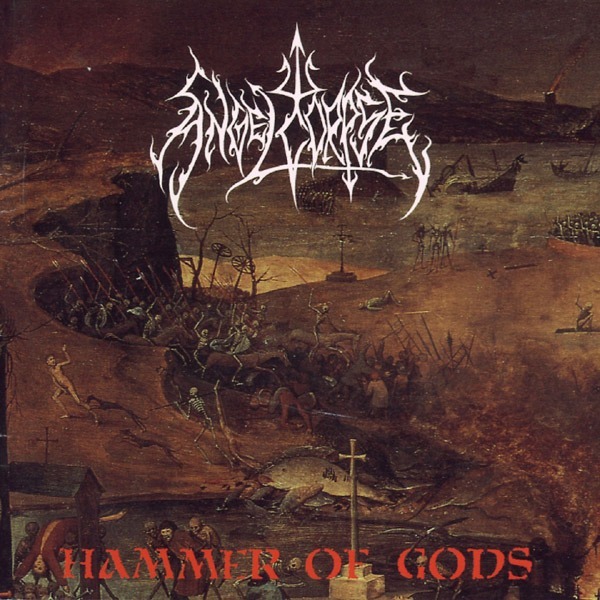
Angelcorpse - Hammer Of Gods [1996]


While their later releases ‘’Exterminate’’ and ‘’The Inexorable’’ will prove to be more cunning and technically surpassing albums, Angelcorpse’s debut album ‘’Hammer Of Gods’’ is not without flaws. The third and second effort are closely related, both possessing a more lively edge and a processed portion of Angelcorpse’s savage attitude, but although ‘’Hammer of Gods’’ is just frenetic and just crazed with erupting blackened death metal fury, it’s clear that it hasn’t fully been turned into a credible substance, thus offering no more than pure demented aggression. Even so, the debut remains as the most frantically driven and it beholds a strength that could reduce any man into cinder within the blink of an eye, therefore ‘’Hammer Of Gods’’ stands as Angelcorpse’s most barbaric incursion, although so of its blows may tend to miss its target.

The overwhelming savagery has an obvious reason here. The musicianship hasn’t properly developed, and therefore we’re left with heaps of uncontrollable energy and callow riffs, enjoyable nonetheless. ‘’Hammer Of Gods’’ big flaw is the lack of prowess, but it’s also devoid of the spiking, sturdy guitar tone of ‘’Exterminate’’ (which augmented even further on ‘’The Inexorable’’), leading us to fibrous riffs, dispersing and scattering vigorously. Of course, the coarse jumble of tremolos and chords are totally gut-splattering. ‘’Hammer Of Gods’’ will punch you with its iron hammer again and again, and it will send a swirling vortex of chaos upon the remainders of your pulverized body to distort even further. Every song is just another strike of the hammer, numbing continuously, and your flesh will be all but gobs of meat when the album ends.

If you want a tantalizing demonstration of Angelcorpse’s early sound, look no further than this record. It’s accessible compared to the band’s demo material but still raw, demented and drunk with power. The drumming is simple, crude blast beats, while the vocals are throatier than ever, and the production is also a futile one, raw and decrepit. I can’t say that this is my favourite old school Angelcorpse record, but I can’t say I dislike it either, because after all, there’s still stuff here that would make your head jut up and down until snaps, and no matter how crude it is compared to its peers, I can’t help but enjoy this berserk black/death album. 

Highlights
''The Scapegoat''
''Lord Of The Funeral Pyre''
''Envenomed''

Final Rating
Awesome [8.4/10]